

Skip to Content

Posts tagged with Facilitation

Premortem: before starting a new project, learn why it will end in failure

A walking path through a forested gulch. A neighborhood bridge goes overhead, partially obscured by the trees.
Photo by Brian Kerr.

A simple method for uncovering big, ‘undiscussable’ risks to a project.

audio-thumbnail
Podcast episode 0035: Premortem
0:00
/547.264

More podcast episodes online or in your favorite app.

Identify project risks using this fun, thought-provoking 15-minute method to capture wisdom from the people who know best—those who will do the work and those who will be affected by it.

It’s the venerable project premortem.

I recommend this method if you’re leading a project in your own organization. And if you’re a consultant, like me, it can be a significant information-seeking behavior at the beginning of a project.

The underlying capability is prospective hindsight. Here’s a definition from Gary Klein, in his HBR piece from 2007 on premortems:

Prospective hindsight—imagining that an event has already occurred—increases the ability to correctly identify reasons for future outcomes by 30%. We have used prospective hindsight to devise a method called a premortem, which helps project teams identify risks at the outset.

The premortem is not a new idea—this 2007 article popularized the technique. However, I keep using it because each time I do, I learn things that are valuable to know at the beginning of a new project—and particularly with a new client.

The power of the premortem is this:

  1. People will just tell you things if you ask them nicely.
  2. And if you ask using prospective hindsight, they will come up with surprising answers, sometimes even mentioning their organization’s ‘undiscussables.’

A few things I’ve learned from premortems

  • That the current effort was the second attempt, and therefore doomed to failure for the same reasons the first effort failed.
  • That the current effort was the third attempt, etc.
  • The existence of a specific policy making the intended change impossible, and that policy-makers were not involved in designing or selecting the project.
  • That the ongoing budget to support this work had already been allocated to a particular technology, program, or team.
  • That people don’t trust or believe their leadership, or the project’s sponsors, or one another.
  • Various discoveries about organizational problems in communication and clumsiness in making changes.

These were all things worth learning quickly—as in, cheap and early—so that possibilities remained for adjustment or better awareness of the environment.

Here’s how it’s done: running your premortem

  1. Before the meeting, write a simple scenario. Something like: “It is December and our project has failed spectacularly. As the first snow falls, we gather together and ask—what happened? Why did this fail?” Be precise about the future date: maybe 2 months after the presumed project completion; link the date to some major event or local seasonality.
  2. Schedule 15 minutes in a project kick-off meeting to run the premortem.
  3. At the start of the premortem, state the scenario and ask the question.
  4. Allow 1-3 minutes for individual reflection.
  5. Offer an anonymous feedback form and invite participants to provide their responses. Clearly state how you will use these, for example, that individual responses remain anonymous, but you will share themes and takeaways with the group and with project sponsors.
  6. After the individual reflection time is complete, open up for a brief discussion across whatever participation modes are available. Acknowledge and thank people for their responses. Do not attempt to problem-solve or diagnose right now, but make it clear you’ll be doing so later. If project sponsors, execs, etc. attend, you will have to coach them on this behavior in advance, the message being: we’re listening now, we’ll problem-solve afterwards.
  7. Close with sincere thanks and by telling people where and when you’ll share takeaways from the premortem—ideally with planned remediations for each.

An encouragement

The project premortem concept may seem a little weird. It is.

But it’s a great way to show up and listen. The simple act of listening to people and adjusting based on what you hear is wonderful.

And, almost as a side effect, the things people mention might be the things that doom the project to failure—or the things that, adjusted and kept in mind, might make it a great success.

October 7, 2025: Edited for length & added new photo.

Open space technology, principle 2: “Whatever happens is the only thing that could have”

Open space technology, principle 2: “Whatever happens is the only thing that could have”
Photo by Brian Kerr. 

Planning for a facilitated event involves being ready to throw the plan away.

A few years ago, a client asked me to run a half-day lean (A3) workshop with her team. I knew my client and a few of her staff, but hadn’t spent time with the whole group before. And it turned out—neither had they.

As we did introductions and settled in, I noticed a few things:

  • Several people were new to the team or the larger organization.
  • Everyone was learning about their colleagues.
  • There were urgent, unresolved, undiscussed topics.

After conferring with my client in front of her team, we quickly scrapped the morning’s plan. Instead, I guided the crew into lean coffee—a simple method for letting participants organize and run their own structured discussion.

And it was great. They got to talk about what they needed to. My appearance in their conference room had the important effect of bringing them together and letting their boss participate as part of the circle rather than running the show. They decided they needed to meet more often—which they continued to do, without my involvement. Success!

Two things made this possible.

  1. My client was willing to use the opportunity as soon as we saw it.
  2. I trusted this group to find its own way, using this principle of open space technology: “Whatever happens is the only thing that could have.” That’s because—see one, do one, teach one—I was lucky enough to have previously seen this put into action by another facilitator.

What the leader must do

In 2006 I participated in my first open space technology gathering—a three-day event hosted by Michael Herman. Watching the way Herman embodied the principles of open space helped me see how powerful it was at letting a group become itself.

Here’s what Harrison Owen’s Brief User’s Guide has to say:

It is the special function of the leader to raise the expectations of the group, and heighten their sensitivity to the opportunities at hand, whatever they may be. … The leader must truly trust the group to find its own way. … Any person who is not fully prepared to let go of their own detailed agenda should not lead.

In open space, the role Owen calls “leader” is really half host, half facilitator. Leadership arises from the entire group.

And this from John Fowles’ novel “The French Lieutenant’s Woman”:

I said earlier that we are all poets, though not many of us write poetry; and so are we all novelists, that is, we have a habit of writing fictional futures for ourselves, although perhaps today we incline more to put ourselves into a film. We screen in our minds hypotheses about how we might behave, about what might happen to us; and these novelistic or cinematic hypotheses often have very much more effect on how we actually do behave, when the real future becomes the present, than we generally allow.

All the time I spend planning for facilitated meetings—prepping agendas, arranging materials, booking rooms, gathering snacks and beverages—is critical to the “cinematic hypotheses” of how I imagine the day could go and the outcomes that might arise from it. It’s important to do this work.

And it’s important to be prepared to discard any such planning whenever a group arises and is ready to find its own way.

  • In a better world, that would happen every single time.
  • In our given world, we must encourage this arising wherever it is found.

Whatever happens is the only thing that could have… as long as you get out of happening’s way.


Open space technology series:

August 30, 2024: Edited for length.

The Strategy / Culture Bicycle: one picture that replaces an infinite amount of bullshit

A strategy method that gets right at the good stuff.

Putting together a coherent, useful strategy for a group is hard.

  • When strategy gets too complicated, intelligibility goes out the window. Nobody will adhere to a strategy they can’t remember. But…
  • When strategy is too simple, it’s merely a container for people to toss their assumptions and pet projects into.
  • And often a group is required to keep a strategy document in order to unlock funding, etc., even though nobody is excited to create it or use it.

Now—as a consultant—I’ve been called upon to create strategic plans and the like that I knew were going to collect dust. The complete and immediate uselessness of the strategy was a foregone conclusion. I’m not proud to say it, but I’ve flown across the country, eaten lousy hotel breakfasts with those weird runny eggs, and hosted elaborate multi-day sessions all in order to generate complicated, detailed strategic plans that nobody wanted, nobody used, and ultimately helped no-one. What a waste!

A couple years ago, in an effort to never do that again, I hit the books. Here’s what I found—it’s my go-to method to help a group of people generate and explain their strategy.

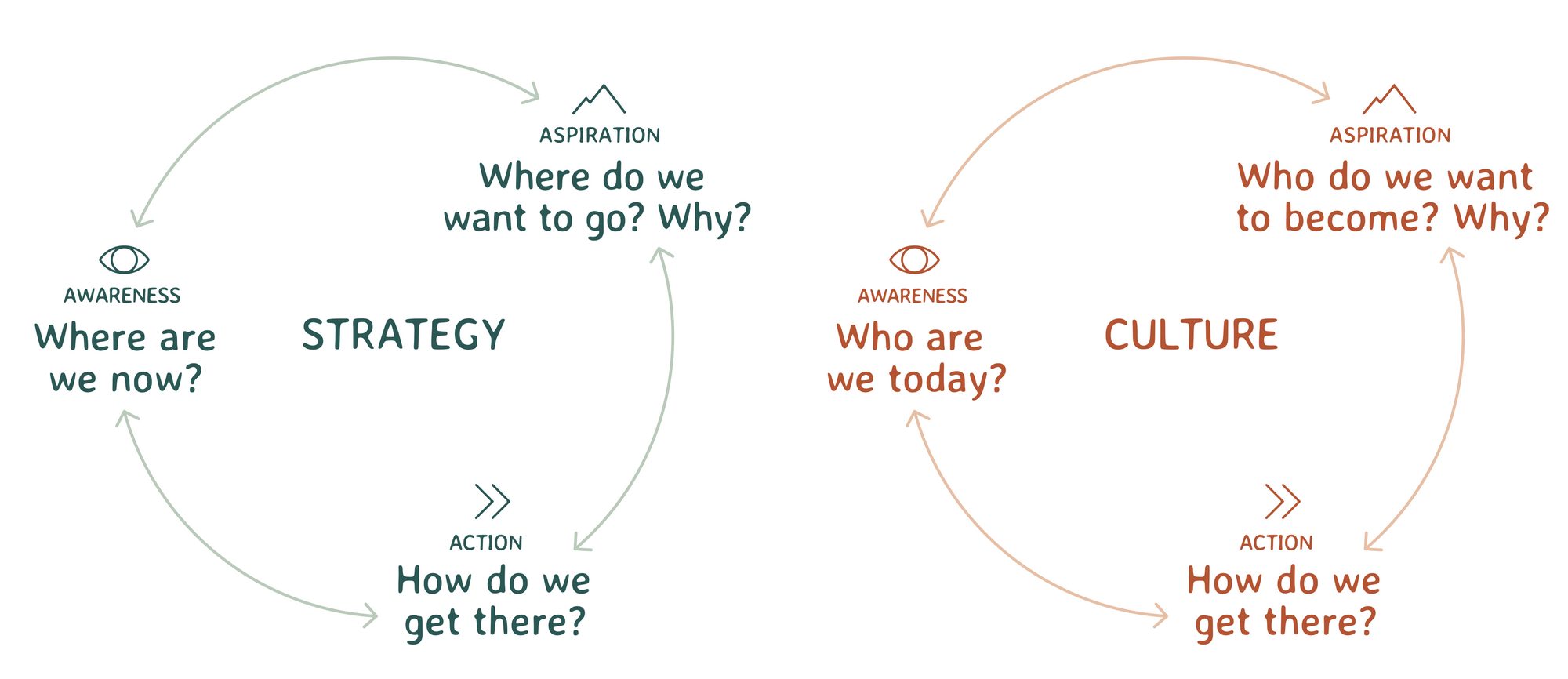
The Strategy/Culture Bicycle:

A wheel for Strategy. A wheel for Culture. And three questions on each wheel which can produce real, meaningful, shared understanding of a group’s intent. When guided by an attentive facilitator, you can get it done in an hour or two and create something amazing. (A detailed facilitator’s guide is available. It is excellent.)

Not part of the Strategy/Culture Bicycle: setting goals, establishing performance measurement, planning. But each of these are way easier to do once there’s consensus on thoughtful answers to these questions.

In my experience, Strategy/Culture Bicycle works for three reasons:

  1. It cuts directly to the big questions without getting mired in a bunch of the inventory-making throat-clearing, fussing about contingency, or working backwards from preferred / “management-approved” actions that overtake many strategy efforts.
  2. The inquiry-based affinity mapping that generates a Bicycle prevents any one person from defining strategy in a way that others can’t, or won’t, support. Autocracy is incoherent.
  3. The Bicycle reminds us that a group needs to have both strategy and culture operating in parallel. Too many strategy documents exist in a timeless void, severed from the people and ways of being which might realize that strategy.

The Strategy/Culture Bicycle was created by Eugene Eric Kim and Amy Wu. I’m grateful for it. It’s in the public domain. Go for it: start with the web-based intro, then move onto the detailed instructions.

And here’s a secret: if you want to figure out who to become and where to go, you can prepare a Bicycle for yourself, by yourself. No lousy hotel breakfast required.

How to make any meeting better with 3 simple fenceposts

How to make any meeting better with 3 simple fenceposts
Photo by Brian Kerr.

Identify a purpose, rational aim & experiential aim—quick actions with a huge effect.

Before your next meeting, write down these three things:

  1. Purpose ← the topic or problem that brings a group together.
  2. Rational aim ← the action, decision, or outcome the group must arrive at.
  3. Experiential aim ← how the group will feel changed by the experience. Express this as a feeling: something like resolved or open or refreshed.

Many meetings begin with only one of these known. The best have all three.

Here’s how to use them:

  • At the beginning of a meeting, share the meeting’s purpose and the rational aim. For example: “We are here today to X. We’ll get there by creating Y and Z together.”
  • Keep the experiential aim to yourself, but keep it in mind.
  • At the end, close with a question that reinforces the experiential aim.

Consensus Workshop

The Institute of Cultural Affairs’ Consensus Workshop is a more elaborate facilitation method. Consensus workshop uses the rational aim and experiential aim to build a fence around group work, and then offers structured planning tools to make sure those aims are met.

For today: keep it simple

Even for short, informal meetings, take a few moments to get clear on the meeting’s purpose and identify both a rational aim and an experiential aim.

  • Knowing the purpose will help the group begin.
  • Knowing the rational aim will help everyone walk the same path.
  • And knowing the experiential aim will help you produce the experience of change or transition that is needed.
May 15, 2024: edited for length.

“What did you notice?” → End your meetings with this short, powerful question

A sign reading “Area Closed for Plant and Wildlife Protection”.
Photo by Brian Kerr.

The simplest technique I know.

“What did you notice?”

Asking this question is an incredible way to close out a meeting or gathering.

Here’s how it’s done

  1. Pose the question: “What did you notice?”
  2. Invite everyone to share an answer, or pass.
  3. Indicate that you'll answer first and point out who’s next.
  4. Give your answer. (I tend to say something like, “I noticed how everyone contributed in their own way and appreciated learning from each of you.”)
  5. Go around the room. Listen. Offer the kindest attention and warmest eye contact you can muster. If someone needs help, ask, “What did you notice?” or the more advanced form, “What’s one thing you noticed?”
  6. When everyone has had a chance to speak, you’re done.
  7. Close with your thanks.

So, what do people say?

Sometimes people share simple things: appreciations and gratitude. For one another. For time together. For kindness or collaboration that has occurred. People might say they noticed conflict, especially if they can point to a moment where it was identified or resolved.

Then a transition happens. This is the magic trick.

It happens in a group of 5 or a group of 50. I don’t know why, but it does. I’ve done this a hundred times in dozens of different groups and each time I worry it won’t happen. It always does. The transition is:

About halfway through, responses shift away from sensory observations and towards the retrospective. Reflection, decision, statements of purpose.

The question hasn’t changed—“What did you notice?”—but the room has.

Maybe some perspective-taking happens. Or someone reinforces shared purpose, especially where there has been disagreement.

By the end, the answers to “What did you notice?” tend toward summary and action. What's next. What's the opportunity. Noticing consensus or its lack.

The group has started with “what” and moved on to “so what” and then “now what.” All with a single question and the lightest structure.

If you want a little more

There are facilitation methods for doing this with a little more scaffolding.

For example, the Institute of Cultural Affairs’ Focused Conversation method is a facilitated discussion that leads a group through stages from Objective to Reflective to Interpretive to Decisional (ORID). Focused Conversations are lovely too, and I use them often.

A simpler version is the “What/So What/Now What” Liberating Structure.

Simpler still is the “what did you notice?” question.

Try it sometime. It’s so simple, it’s magic.

May 15, 2024: edited for length.

Open space technology, principle 1: “Whoever comes is the right people”

Open space technology, principle 1: “Whoever comes is the right people”
Photo by Brian Kerr.

What's the use of a crowd?

"Whoever comes is the right people."

I love the slight awkwardness of this sentence as it describes what happens when people (plural) become a people (singular). A people as a process, not as a shuffling, muttering crowd of individuals.

I can think of only two contexts where I’ve experienced this “peopleing”—

  1. Open space technology. This is a lightly facilitated, carefully organized format for a gathering. Open space is convened on a challenge so puzzling that people are compelled to show up to work and listen. It is the most direct, accessible format for group self-organization I’ve ever encountered: both a chapel and a chainsaw.
  2. The Buddhist sangha, in its various permutations. I keep a mailing list of 75 of us who sat weekly for some years in a frigid room before COVID sent everybody home. Over time, I learned some incidental details (occupation, class, family composition, neighborhood, etc.) about maybe 1 out of 8 of those people. But in terms of the topic at hand—styles of meditation, preferred traditions, favorite teachers, etc.—I still recall where each person was and where they were headed, even though we haven’t met since early 2020. Similarly, I sat on a week-length retreat with 50 people and felt like I came to know them so deeply, and shared something so precious, even though what we shared together was silence. These groups—this sangha—is vital, even though it is transient or ‘incomplete’ in a conventional sense.

We’d all benefit from more spaces where two people, or two hundred, could gather and say—“I don’t know anything about you, and you don’t know anything about me, but we have what we need to get this sorted.”

It is an antidote to the social atomization inhibiting our lives under capital.

And until we get there, it’s a hell of a way to organize a meeting.


Open space technology series:

August 30, 2024: Edited for length.