Skip to Content

Posts tagged with Podcast

Everybody’s a facilitator, whether you know it or not. Three ways to learn the most human skill going

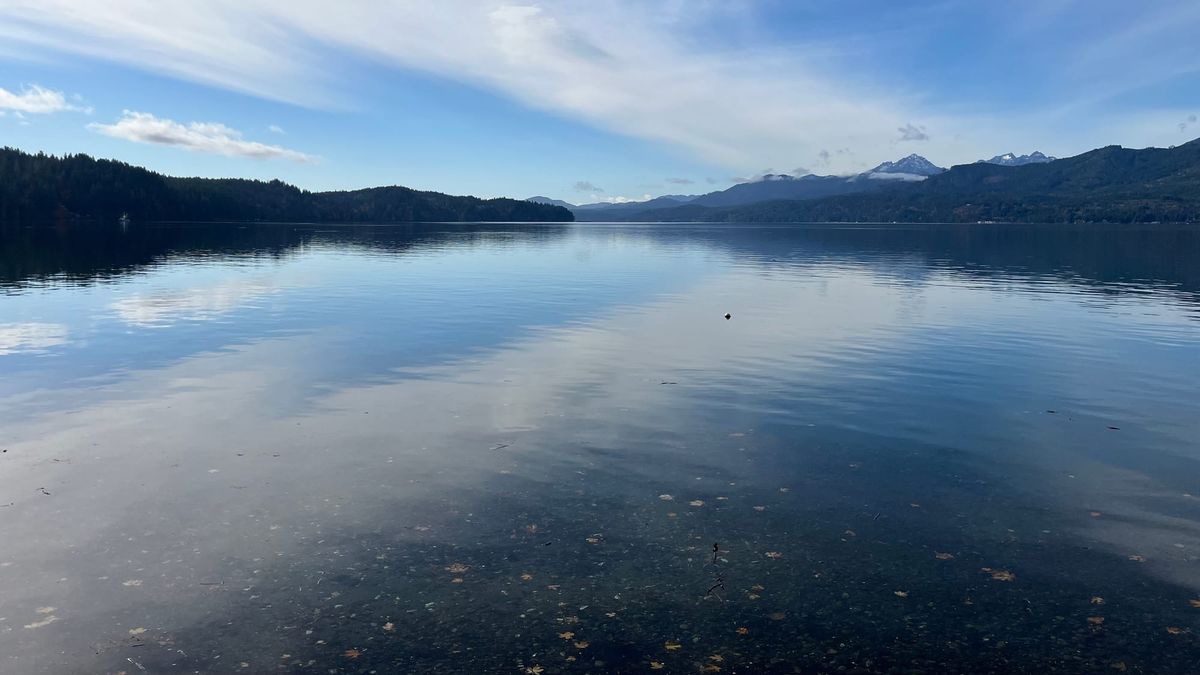
A line of evergreen trees and a blue summer sky with some wispy clouds.
Photo by Brian Kerr.

Facilitation is always happening. If you put even a little effort into learning facilitation, you’ll get meetings of all sorts to the best possible outcomes & help everyone around you have a better time.

audio-thumbnail
Podcast episode 0047: Everybody’s a facilitator
0:00
/823.4866666666667

More podcast episodes online or in your favorite app.

Have you ever met someone who calls themselves a facilitator? It’s not the most common job, but they’re out there. For every facilitator you meet, you’ll meet a dozen people who don’t use the title but treat it a skill they pay attention to and develop over time. And for every one of these, you’ll find a hundred people who have no real idea of what facilitation is. When they have to run a meeting they fall back on boring, stultifying time-wasters like presentations, open discussions, and brainstorms.

Any gathering of 3 or more people is being actively facilitated, whether the hosts realize it or not. Whenever you’ve felt bored or disengaged in a meeting and had to sit there, that meeting was poorly facilitated. For a lot of us, ‘work is just meetings,’ so this adds up to a huge, frustrating waste of time.

Poor facilitation is everywhere and it’s terrible. No amount of happy crappy from an LLM chatbot or beautiful slides from a consultant can deal with this. It is a separate, deeply human thing that has to get sorted out if we want to solve problems and act skillfully as groups in the workplace. The meeting cost calculator is running.

And for the most part, meeting or workshop facilitation is not the main thing people want to deal with. They’re focused on the people, problems and decisions at hand.

So my question is—where do people learn this stuff? I’ve noticed three ways. People learn facilitation:

  1. informally,
  2. formally, and
  3. by practicing.

Let’s look at each. I’ll share my experience, some findings from an industry survey, and a few starting points or offerings.

How I got my facilitation chops

I got interested in facilitation as a grad student back in 2006, when I went to a niche web collaboration conference down in Portland. I thought I was going to hang out with pals and compare notes on nerdile web stuff on my department’s dime. But this conference was structured using open space technology and hosted by Michael Herman. After seeing how he worked, I wanted to do it myself. This is like saying you got interested in guitar after seeing Roger Waters play in a coffee shop.

I stuck with that interest. First, as a way to scoot through grad school—an environment where I saw a lot of very effective and very lousy facilitation in the classroom (teaching is a kind of facilitation). I survived many boring lectures by paying attention to what people were doing poorly, and wondering what they might do otherwise. Later, it gave me an edge in my technical consulting work. I could get people to a decision or a working consensus on what to do next.

I put together an invisible curriculum for myself, in three ways:

  1. Informally, by going to local conferences with demos and workshops on facilitation methods to see a variety of approaches as used by different people. This was during the initial heyday of Liberating Structures and Lean Coffee in the Seattle area, so these were easy to access.
  2. Formally, by getting training and certifications. In my experience, the best of these are the Technology of Participation series from the Institute of Cultural Affairs (more on this later).
  3. And most importantly, by practicing. The school of hard knocks. My consulting work by this time involved planning and hosting a lot of meetings—continuous improvement workshops, human-centered design activities, public engagement sessions for government agencies, and the like. So I had opportunities to practice, and get feedback. It’s one thing to get trained in a method. Another thing to try it out during training. Still another to run it over and over in different groups solving different problems until you know what’s what.

What I notice today is this. While clients don’t tend to hire me for facilitation, that’s a big part of how we end up getting the work done. I say ‘we’ pointedly here, because spreading facilitation practices, or leaving them behind after a project is done, is one of the most durable things I do for clients. It’s something people don’t know to ask for, but they sure appreciate when they see it, and they keep using it afterwards.

How most facilitators learn

Let’s turn to SessionLab’s “State of Facilitation” report. This is a vendor of meeting planning software I’ve never used; but they commission this free annual report which is super valuable.

From this year’s report, note that only half of the respondents have a formal accreditation or training certificate related to facilitation. And of those that do, there’s a pretty wide spread:
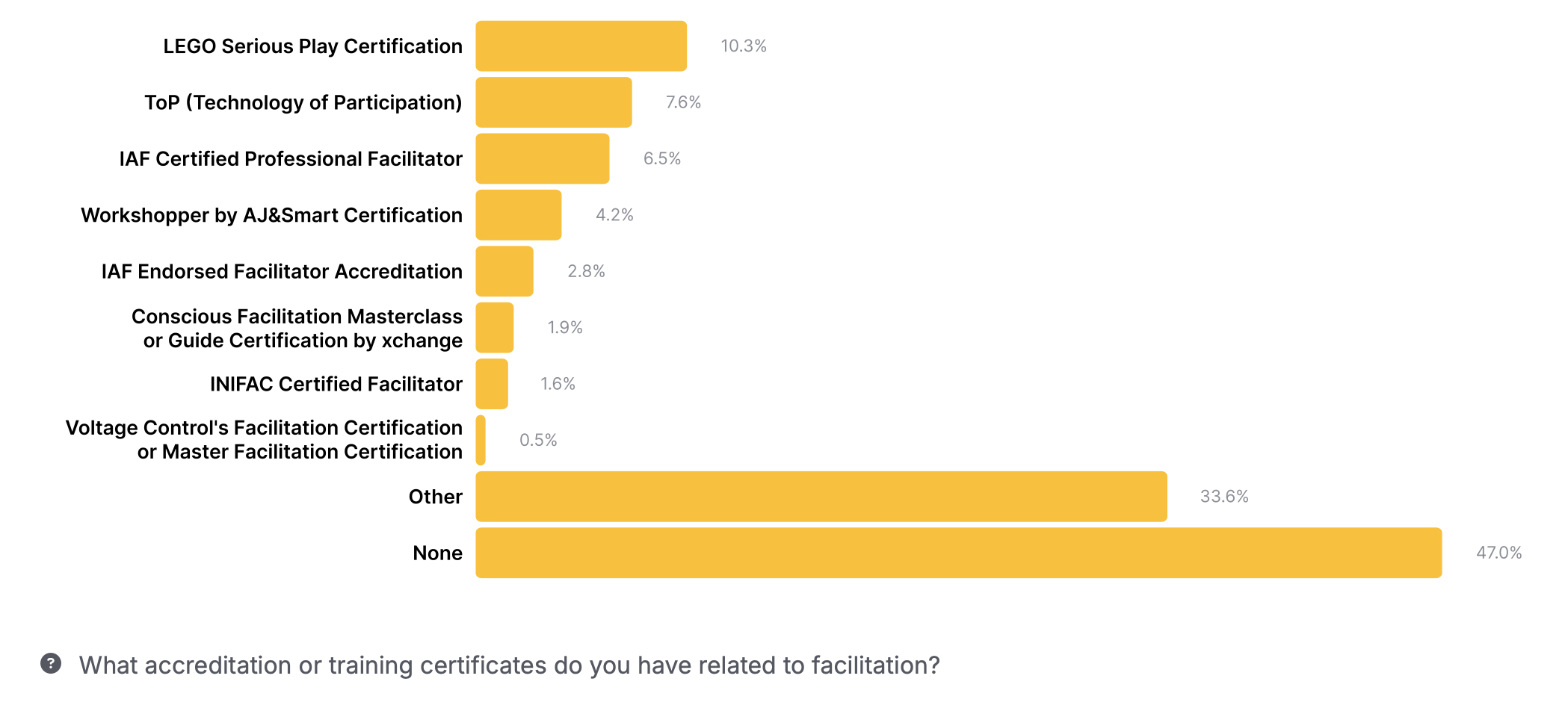
From SessionLab’s State of Facilitation Report for 2026.

I don’t see this as a bad thing at all. Of our three ways (informal, formal, and practice), only the second is produced by training. More practice needs to be available, in addition to more training, because learning happens in the doing and teaching:
3-step method for learning anything
See one, do one, teach one ← That’s the method.

Another big opportunity people use to learn facilitation is feedback and evaluation. For the first time, this year’s “State of Facilitation” survey asked questions about evaluation. Here’s how facilitators say they’re measuring success:
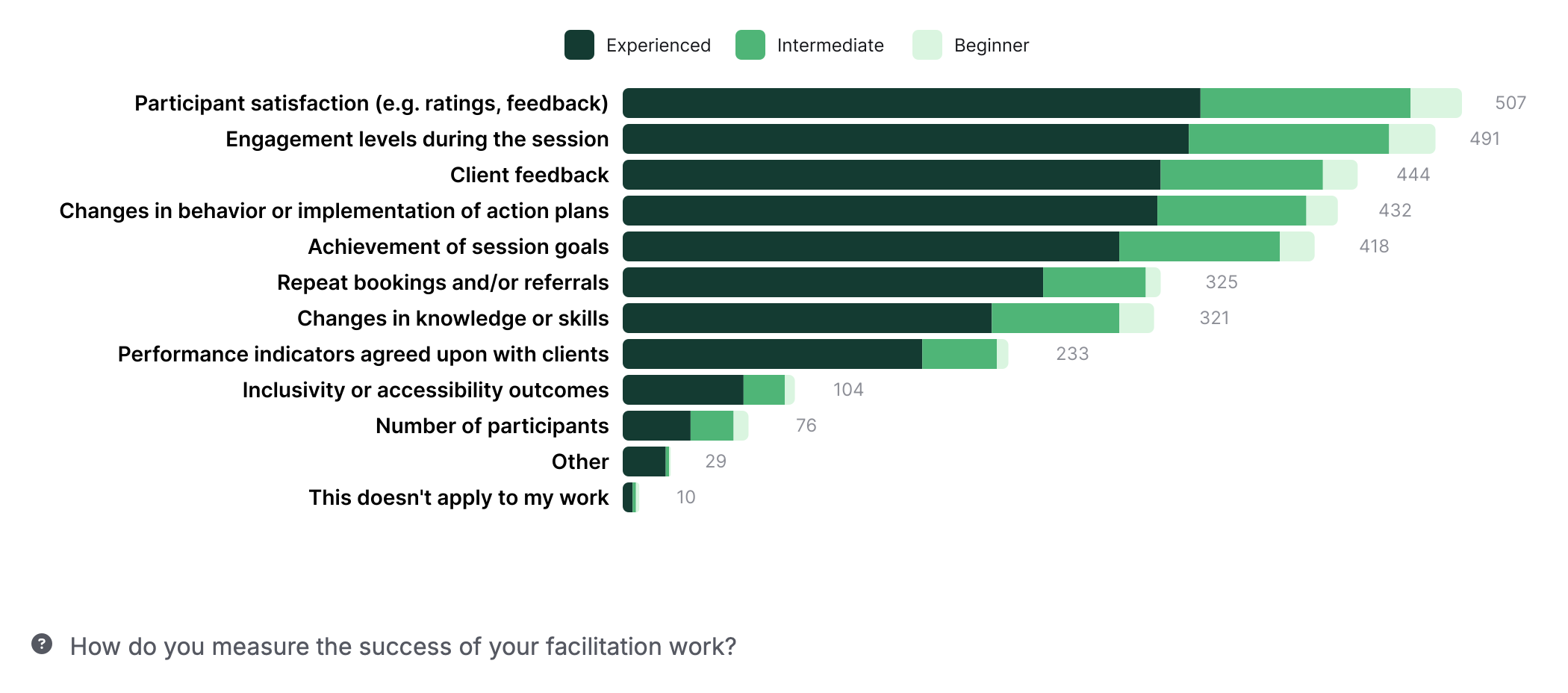
From SessionLab’s State of Facilitation Report for 2026.

Notice the weighting toward activity measures, which you could think of as ways to prove that the work got done. These are also the kinds of measures that provide quick feedback items for the facilitator to build into their future sessions. So they help with everybody getting paid, feeling good, and making improvements next time. These are all good things.

You have to get down to the 7th or 8th most common responses to get to anything related to measuring results or lasting impact for the organization.

General advice for performance measurement: you want a mix of both activity and results measures. I bet most of the evaluation shown in the chart above happens too quickly after a session to speak to impacts. And that is related to the “drive-by consulting” nature of much paid facilitation work.

Personally, I’ve only been able to tease out the impact of my facilitation work by going back to clients years or even a decade after the fact (hi Susan!) to learn what really took hold after my consulting team moved on. In some cases it was a specific habit for closing a meeting that they kept doing. In others, a way of documenting/arguing about a problem that stuck. Or in one case, a method for deciding how to schedule projects that our client’s boss liked and ended up using across her whole division. Facilitation is happening everywhere.

Three ways you can learn facilitation, starting today

(1) Informal ways

Seek out meetings, workshops, events, community gatherings, and the like. Pay attention to the facilitation as well as the content. Spend half your time looking at whoever is running the event, and half your time looking at everybody else. When are people bored? When does someone perk up? Who’s disengaged, and why? Who gets shut down early and doesn’t participate again?

(2) Formal ways

I whole-heartedly recommend the Institute of Cultural Affairs’ Technology of Participation (ToP) Facilitation Methods course as a starting point. You can take it in person around the world, or online. It is the only facilitation training I’ve taken that has not been a waste of time. And I use elements from it weekly.

(3) Ways to practice

And for practice, well, ya gotta practice. That’s not to say I can’t help you, though.

Over in the Continuous Improvement Studio, I have two items of interest:

  1. A free set of facilitation zines. You can print these and bring ’em into your next meeting to run a group check-in or a project launch.
  2. A fixed-price service that will make your next high-stakes meeting a delight. I love facilitating meetings, and this is where I get to spread the love by sharing the structure and confidence that helps people enjoy it as much as I do.

And here on the site, there’s plenty to browse through:
Facilitation - Improve Something Today
“Enough of Science and of Art; / Close up those barren leaves; / Come forth, and bring with you a heart / That watches and receives.” (Wordsworth)

So my invitation is this. Find one activity in one of these three ways of learning and give it a shot. I’d be delighted to hear what you picked and how it went.

Podcast episode No. 0046: What the heck is Brian up to?

A cool-looking view of some waves in a body of water.
Photo by Brian Kerr.

A professional update, some new things, a request, and a reading.

audio-thumbnail
0046: What the heck is Brian up to?
0:00
/746.7093333333333

Episode details

A professional update, a (re)introduction to three main things I’m working on, and a reading from Christopher Alexander et al’s “A Pattern Language.”

  1. Improve Something Today (this site!)
  2. Continuous Improvement Studio: field guides, templates, etc.
  3. Different Chairs: consulting services

More podcast episodes online or in your favorite app.

What kind of water is this like? A simple practice for noticing awareness

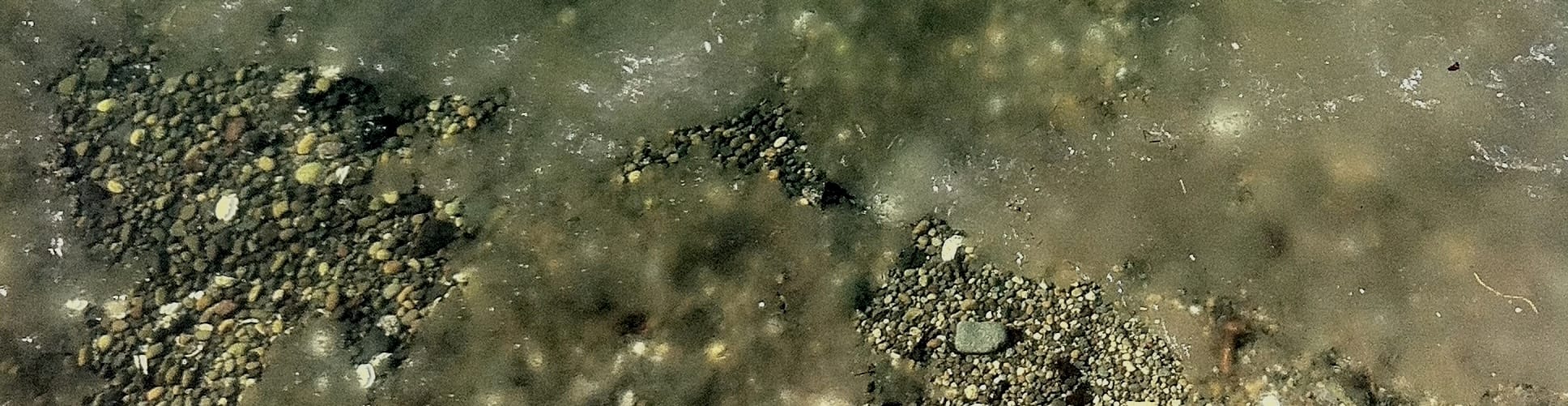
A very thin sheet of ice over a shallow body of salt water. Nearer to shore, the ice breaks and one can see the rocks at the bottom of the water.
Photo by Brian Kerr.

A momentary observation for seeing the quality of your experience without, hopefully, worrying too much about how or why.

audio-thumbnail
Podcast episode 0042: What kind of water is this like?
0:00
/147.11466666666666

More podcast episodes online or in your favorite app.

You know I love simple practices. This is one of the simplest, coursing down the centuries since, at least, these discourses in the Pāli Canon where the Buddha is in conversation with a guy called Saṅgārava. Now Saṅgārava seems to have been a stand-in or container for various questions and metaphors about water.

You might be thinking of that cliche about ‘mind like water’. Sure, but let’s ask: what kind of water, and in what way? Water as it changes in time and place and circumstance is an example of something that is always becoming otherwise. It has this in common with you, and me, and everything around us, and in us.

So the practice, as I’ve learned it from two different teachers at two different times, is this. Take a moment and notice your own awareness. What kind of water is this like? Perhaps still, or flowing, or murky, or raging, or a turbid estuary, a snowflake or an ice sheet, or overgrown with algae, or a trickle in a dried-up stream.

As you do this, there is no need to adjust, to evaluate, to search for reasons or explanations or blame. It is a practice of noticing, and noticing only—a chance to recall or identify one sensation that is most similar to another. Some qualities are more pleasant or useful than others. And whatever it is now, it will soon be otherwise.

Five contributions to a project: money, effort, attention, memory & wisdom

A line of trees alongside a lake shore on an overcast day.
Photo by Brian Kerr.

Following on Jerry Weinberg’s point that ‘the money is usually the smallest part of the price,’ what other prices are to be paid, and how should a consultant approach these contributions?

audio-thumbnail
0045: Five contributions to a project
0:00
/191.40266666666668

More podcast episodes online or in your favorite app.

In a recent discussion amongst independents and consultants on pricing, I was reminded of this quote from Jerry Weinberg, one of his ‘laws of pricing’ for consultants:

The money is usually the smallest part of the price.

I see five contributions to successful consulting projects: money, effort, attention, memory, and wisdom. You’re going to need each of these to pull any nontrivial project off.

Knowing this, you are equipped to notice that a broad set of people might end up making these contributions. Not all of them will know or care about your work in advance. They may not even be associated with the organization that is hiring you.

Your direct client will put in a lot of effort and attention. But they may have a boss or sponsor who directly or indirectly approves the budget, and someone else might actually pay the money. Effort will come from many other people too: everybody you bring into a meeting or workshop, for starters. Spending time, paying attention. See these words we use?

Memory and wisdom are squishier. Some people know what’s what, what has happened, and how things got into the mess they’re in today. If you can find these people and learn from them, that is their contribution. Wisdom is sometimes embodied in memory, sometimes not. However you find it (hint: listen for the undiscussables), wisdom is the greatest gift of all.

My suggestion is this: consultants should attend to each of these contributions with the same level of care as they would pricing. I think a lot of us do this instinctively. But it’s good to do it deliberately, and to draw a picture as we go. In the same way we’d justify a monetary price by showing what we’ll give in return and why that’s important, we can justify each of these other contributions to the individuals and groups making them, and receive them with gratitude.

Remembering Christopher Alexander: love even for the smallest pebble

A stone walking path going up a gentle incline with winter foliage surrounding.
Photo by Brian Kerr.

Two passages from the architect and writer on the fourth anniversary of his passing.

audio-thumbnail
Podcast episode 0039: Remembering Christopher Alexander
0:00
/306.21866666666665

More podcast episodes online or in your favorite app.

Christopher Alexander, architect, passed away four years ago today. He was a direct influence on several of my teachers, mentors, and friends, although I knew him mostly as a warm writer of challenging ideas. The independent consulting company I ran for a decade was called ‘Different Chairs’ after a passage he cowrote.

First, let’s enjoy the crispness of Alexander’s writing. Here’s a passage from his first book, Community and Privacy, coauthored with Serge Chermayeff, published 1963:

People want to be everywhere. The reason they moved out was to find the country and escape the disadvantages of the city. The reason they are moving back is that the country is no longer there and they would like to regain the advantages of the city. But when everything is everywhere, wherever you go there is nothing tangible to find.

Second, we dwell in the inviting and clarifying nature of his work. This passage is from the concluding pages of his last book, The Battle for the Life and Beauty of the Earth, with Hans Joachim Neis and Maggie Moore Alexander, published 2012:

Again and again we are confronted daily by decisions, by the question, “What should I do, what path should I take, how should I approach this problem?”

There is no human being who does not, in some form, encounter this kind of self-doubt. Every one of us needs help or guidance in doing the best possible thing, in so far as what is available and practical, on the day when you encounter this question, in yourself.

Gandhi-ji, Christ, the Buddha, Aung San Suu Kyi in Burma, and the man down the street at the gas station. They did it for love. I can do it for love. Any one of us can do it because of love, and because love is simple and so powerful.

Love itself! Not love for this person or that person—but love for a small spider who has fallen into a tin can, love for the field which nourishes, and the individual grasses that sway as the breeze comes gently across.

The ecology of humankind is created by the fabric of buildings, by the human fabric of affection, and by the powerful force of our love for our Earth—love, even for the smallest pebble.

Try to be aware, every waking day and every minute, of the love that lies in your heart. The most tender wakefulness lies in your heart, and gives you the only realistic picture of the world. It can give you access to the ultimate reality. At every moment, remain wakeful and aware of your love for the Earth and for the Universe around you.

I showed up to some consulting work this morning befuddled, tired, and uncertain of which of several alternatives—all equally irritating—to pursue next. This inside the universal local/global backdrop of loss, confusion, and cruelty. Remembering Christopher Alexander’s answer to ‘what should I do?’ has helped me a hundred times over across the years, including today, right now. Maybe it will help you, too.

Thanks, Christopher.